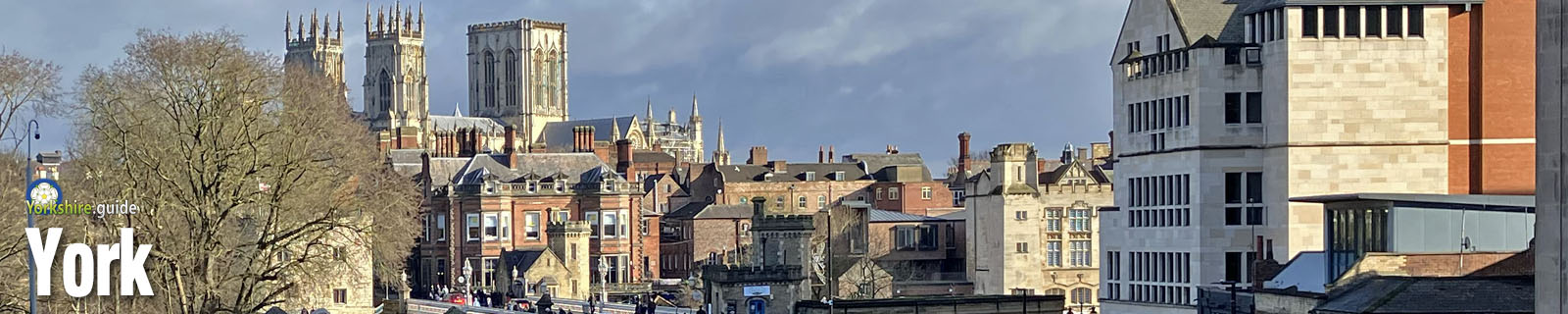
City of York
The city attracts millions of visitors each year to visit its attractive streets of period shops, to shop at its open market, to walk the city walls or to visit its Minster and its vast range of museums and visitor attractions.
York has something to offer in every season. Spring always adds a splash of brightness to the city with its sea of golden daffodils around the walls and Easter is always a busy period in the city.
It's hardly surprising that York was rated Britain's favourite city with a 92% approval rating in a 2018 YouGov opinion poll, TripAdvisor ranked it among the five best destinations in the UK in 2018 and the city was also ranked by The Sunday Times as the overall UK winner of Best Places to Live 2018.
After withdrawal of the Roman legions in the early 5th century, the city became the trading port of Eoforwic and capital of the Saxon kingdom of Deira. In the mid-7th century Deira combined with Bernicia to make the Kingdom of Northumbria. The conversion of Edwin, King of Northumbria, to Christianity at York, and the building of a wooden church in 627 for his baptism, was to go on to see the city become a centre of church importance second only to Canterbury.
A new chapter in York's history began when it was captured in attacks in 866 and 867 by Danish Vikings. Vikings settled in the city, which they named Jorvik, establishing workshops, trade and agriculture in the region around.
The following 200 years were a period of turmoil with local rebellions and new invasions from Norway. Events culminated in 1066 at battles near York at Fulford and Stamford Bridge after an invasion led by King Harald III of Norway and Earl Tostig, brother of the recently-crowned Anglo-Saxon English King, Harold II. The Norwegians gained a victory at Fulford, but five days later the invaders were defeated by King Harold, whose troops had marched quickly north. The journey back to the south coast was equally challenging and ultimately left England in the hands of the Normans after Harold's death at the Battle of Hastings three weeks later.
In 16th century York, Guy Fawkes was born just a stone's throw from York Minster. The country still holds its annual celebration of the thwarting of his gunpowder plot at Westminster on November 5 in 1605.
Railways played an important part in distributing York's chocolate wealth. The main line from the North East to London was built through York providing direct trains to London by 1840. With it came a huge industry in carriage building and repair, one which has also sadly seen decline in recent years, but the city is still well-served by trains to all parts of the country and the city's rich railway history can still be seen at the National Railway Museum in York.
 City features
 City Walls
The city's splendid medieval walls surround most of the city centre and are partly built on Roman foundations. After some restoration since the 19th century, the walls are the most intact city walls in Britain and can be walked for most of their length. York Minster
York Minster is one of the world's most magnificent cathedrals and among the largest Gothic cathedrals in Europe. Work was started on the present cathedral in about 1230, although there have been at least three previous cathedrals on the site and the remains of the Roman Basilica have been found beneath the building. The cathedral was declared complete in 1472. Clifford's Tower, York
Tower Street, York
Clifford's Tower is the largest remaining part of York Castle. The original castle was built of earth and timber by William the Conqueror in 1068 and survived the damage of revolts against the Norman king and an attack by Danish Invaders. The tower was burned down in 1190 though, after York's 150-strong Jewish community were beseiged there to become victims of a mass suicide and massacre. The present stone tower was completed about 750 years ago, built on the motte of the earlier wooden towers. It is thought to have been used at one time as a treasury and became a part of York jail before becoming a tourist attraction in the 20th century. The tower is now managed by English Heritage and reopened to the public on April 2, 2022 after a £5m makeover involving modern internal walkways and a viewing platform roof. Find out more at this  English Heritage - Clifford's Tower
English Heritage - Clifford's Tower Find on map:  Clifford's Tower, York
Clifford's Tower, York St Mary's Abbey ruins
York Museum Gardens
The ruins of the St Mary's Abbey Church are among the features of the York Museum Gardens. The Benedictine Abbey was once the richest in the north of England. Although the original church on the site traces its origins to the mid-11th century, the remains are from a rebuilding of the church in the late 13th century. Museums: Some of the wide selection are detailed below.
 York offers a unique vintage shopping experience in its paved shopping streets together with an array of gift, antique, fashion, book and chocolate shops as well as the usual big high street names. Regular open air and farmer's markets offering local produce add to the old world atmosphere and a St Nicholas Market is held in the city from mid-November to December 23. Just off the
  York has city centre Post Office brances at Coney Street, Micklegate, Colliergate and Walmgate, and there are also a number of other offices around the city.
 York has bank and building society branches.
 York has several pharmacies.
  The city has a good range of pubs, including historic and more modern bars. Some offer a range of locally-brewed ales and most have a food menu.
 York has an abundance of restaurants, cafes and pub eateries with a huge selection of menus catering for all tastes.
 The York central library is in Library Square. It is one of several libraries in the City of York district which since 2014 have been run by Explore York Libraries and Archives, a mutual benefit society with charitable status.
 Further information at the Explore York Libraries and Archives website.
Explore York Libraries and Archives The city has a number of public toilets, usually with a 40p charge. Among centrally located ones are toilets at St Leonard's Place, Silver Street and the Coppergate Shopping Centre.
 There is a full list at the City of York Council - Public toilets directory web pages.
City of York Council - Public toilets directory
 There are many schools throughout York and its districts and the two universities detailed below.
 The River Foss joins the River Ouse at York. River cruises along the River Ouse are among the city's highlights.
 Universities
The University of York
Heslington
The University of York was founded in 1963 and has since seen major expansion on a parkland campus around lakes near Heslington Hall about two miles from the centre of the city. More information at The University of York website.
The University of York York St John University
Lord Mayor's Walk
York St John University is on a campus just outside the city walls close to York Minster. It was originally founded in 1841 as the York Diocesan Training School. Having gained degree awarding powers in 2005, it became York St John University the following year. Further details at the York St John University website.
York St John University Museums
York has a wide range of museums covering the history of various periods and themes. They include: National Railway Museum
Huge halls of locomotives and trains feature in this exhibition covering Britain's railway history from early horse-drawn and steam power to modern high speed trains.
More details at the
Railway Museum Yorkshire Museum
The Yorkshire Museum features exhibits ranging from dinosaurs to a 11,000-year-old Mesolithic pendant, Roman, Viking and medieval discoveries. The museum is set in botanical gardens also featuring the ruins of the medieval St Mary's Abbey.
More information at the
Yorkshire Museum York Castle Museum
Set in 18th century prison buildings, the museum shows how York and its castle have been a site of justice for nearly 1,000 years, with stories including the legendary highwayman Dick Turpin and the last woman to be burnt at the stake in Yorkshire. The museum also features a recreation of a Victorian street, a water mill and exhibits from time of change in the 20th century. The museum also has exhibits from the city's chocolate-making past, in particular Terry's, which produced chocolate in York until 2005 and could trace its history in the city back to 1767.
More details at the
York Castle Museum Jorvik Viking Centre
The centre, owned by the York Archealogical Trust, shows York's Viking history with a journey through scenes recreating its Viking streets. The centre has been fully refurbished after flooding in 2015 and offers a ride through animatronic figures amid the sights, sounds and smells of York's 10th century streets.
More information at
Jorvik Viking Centre Richard III Experience
Monk Bar
An exhibition in one the York city gateways of the life of King Richard III who maintained close connections with York during his two-year reign before his death at the Battle of Bosworth in Leicestershire in 1485, the last English monarch to have been killed in battle. The upper storey of the Monk Bar gateway was completed in Richard's reign. Further details at the Richard III Experience website.
Richard III Experience Henry VII Experience
Micklegate Bar
This exhibition about the first Tudor king and Tudor times is situated at Micklegate Bar, the main gateway to the city and a place where the heads of traitors have been displayed. King Henry would have entered the gateway on his first visit to York in 1486, the year after his coronation and the year he married Elizabeth of York. Elizabeth was the eldest daughter of King Edward IV, elder sister of King Edward V and niece of King Richard III, the latter having been killed in the War of the Roses battle fighting Henry's Lancastrian army at Bosworth in Leicestershire. While she might have had a strong claim to the throne herself, she became Queen Elizabeth as Henry's consort, her coronation taking place in 1487. Her granddaughter, born 30 years after her death, would ultimately become the last Tudor monarch, Queen Elizabeth I. Information at the Henry VII Experience website.
Henry VII Experience Barley Hall
Coffee Yard
Built as the York townhouse of Nostell Priory, near Wakefield, the earliest parts of Barley Hall date from around 1360. The hall was later used by the Lord Mayor of York in the 15th century. In recent times it had become hidden behind a modern facade, but was bought by the York Archaeological Trust in 1987. Following work to restore the hall it was reopened to the public in 1993. Inside it has been decorated as it might have been as the mayor's family home in the 1480s. More information at the Barley Hall website.
Barley Hall York Army Museum
Tower Street
Regimental Museum of The Royal Dragoon Guards and The Yorkshire Regiment. Further details at the York Army Museum website.
York Army Museum Yorkshire Museum of Farming
Murton Park, about 3 miles east of the city centre, is the location of the Yorkshire Museum of Farming, which has a wide range of historic agricultural machinery and implements, a large photgraphic collection and a gallery deticated to the Women's Land Army. The park is also the home of the Danelaw Centre for Living History and the Derwent Valley Light Railway, where trains are run on Sundays and Bank Holidays on the surviving half-mile of this former 16-mile agricultural light railway.
More information at the
Yorkshire Museum of Farming Yorkshire Air Museum
The Yorkshire Air Museum is at the former RAF Elvington, about 3 miles south-west of York. During World War II it was an RAF Bomber Command Station used by Allied bomber crews, including French Air Force squadrons. The museum now situated there has a huge range of exhibits taking visitors from the earliest pioneers of aviation, including Yorkshireman George Cayley, through both World Wars and the Cold War era. More than 60 aircraft and flight-related vehicles are on show at the airfield. The museum is also the location of the Allied Air Forces Memorial, commemorating all allied airmen and women.
More details at the
Yorkshire Air MuseumFind
Yorkshire Air Museum Sport
Sport
 York City Football Club
'The Minstermen' play soccer at the York Community Stadium. Official website: York City FC
York City FC York City Knights
Play rugby league at the York Community Stadium. Official website: York City Knights
York City Knights York Racecourse
The Knavesmire
Holds race meetings througout the season. Its most important meeting is the Ebor festival in August. Official website: York Racecourse
York Racecourse Entertainment
York Theatre Royal
St Leonard's Place
With a history of drama stretching back 250 years, York Theatre Royal reopened earlier this year after a £6m redevelopment. It provides a wide variety of performances, pantomime, ballet, events and activities. Grand Opera House York
Cumberland Street
The Grand Opera House provides a venue for a wide range of touring shows by national and internationally acclaimed theatre and ballet companies, entertainers and musicians.

 Travel
York station
Station Road
The present York station layed claim to being the largest station in the world at the time it opened in 1877. The station is on the East Coast main line with regular services to London King's Cross, North East England and Scotland, the Midlands and South West England, regional expresses across Yorkshire and stopping services for stations toStation managed by: LNER. Operator/s: LNER, CROSS COUNTRY, GRAND CENTRAL, TRANSPENNINE EXPRESS, NORTHERN.
 NATIONAL RAIL - Departure and station info
External link to National Rail live departure board for services at this station (opens in new tab).
Bus travel
There are bus connections to other Yorkshire towns and cities including
City of York Council have an extensive i Travel York website providing all sorts of information on travelling around York by bus and other transport methods and the city's six Park & Ride schemes.
i Travel York website Car travel
Main routes to the city are the Space in the city centre is limited and some of the centre's streets narrow and pedestrianised. The city has six highly-successful park and ride sites, at Askham Bar, the Designer Outlet, Grimston Bar, Monks Cross, Poppleton Bar and Rawcliffe Bar. Parking is free, the return bus fare is £3.30* and environmentally-friendly electric buses now provide the link on some routes. *As as August 2021
i Travel York - Park & Ride Emergency services
North Yorkshire Police North Yorkshire PoliceNorth Yorkshire Fire and Rescue Service
North Yorkshire Fire and Rescue ServiceYorkshire Ambulance Service NHS Trust
Yorkshire Ambulance Service NHS Trust Local government
Unitary authority
 City of York Council
The City of York unitary authority covers the city centre and an area of roughly five miles radius from the centre, which includes some of the rural land and villages in the Vale of York beyond its outer ring road which were previously part of Harrogate, Selby and Ryedale districts of North Yorkshire.
The area is divided into 21 wards and 47 councillors are elected with between 1 and 3 councillors per ward. The full council is elected every four years, the most recent full election being in May 2019.
Link to City of York Council website.
City of York CouncilThe political composition after the May 2023 election is :
County strategic authorities
York and North Yorkshire Combined AuthorityThe York and North Yorkshire Combined Authority was created in December 2023 combining the unitary authority of York and the unitary authority of North Yorkshire — that created in April 2023 after the abolition of the county authority and its seven district authorities. The combined authority will run some functions under a mayor to be elected in May 2024 as part of the government's so-called "Devolution deal" which ties the availablity of funding to the new governance arrangements. As well as having powers over housing development, transport and boosting skills and education across the 3,214 square miles of York and North Yorkshire, the elected mayor will also take on the role and functions of the Police, Fire and Crime Commissioner across the area.
York and North Yorkshire Combined AuthorityWest Yorkshire Combined Authority
Although the City of York is not joined to
 York
York Bradford
 Calderdale
 Leeds
Leeds Kirklees
 Wakefield West Yorkshire Combined Authority
Police, Fire and Crime Commissioner
Police, Fire and Crime Commissioner North YorkshireCovers the county of
City of York Police, Fire and Crime Commissioner North YorkshireParliamentary constituencies
York CentralElected MP:
York Outer
Elected MP:
National government region
Yorkshire and the HumberCeremonial county
North YorkshireHistoric
-1974 County Borough not within a Yorkshire riding.1974-95 District authority within county of North Yorkshire.
1995- Unitary authority with enlarged boundaries.
Also in Yorkshire.guide
Home Travel Places to Visit